


How Enterprise Software Integration Helps Modernize Legacy Systems

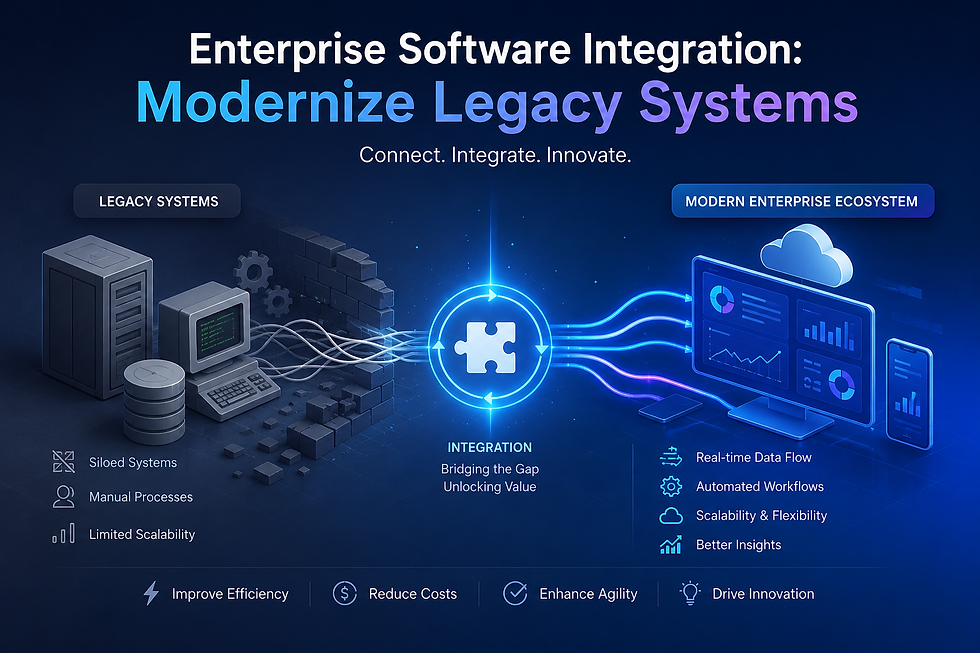
Many established businesses still depend on legacy software to manage critical operations. While these systems may be reliable, they often struggle to communicate with modern cloud applications, AI platforms, and digital tools. This creates data silos, manual workflows, delayed reporting, and increasing maintenance costs.
Why Legacy System Integration Is Challenging
Legacy platforms were generally designed for centralized and predictable workloads rather than today’s real-time, connected business environment. When organizations attempt to connect them with modern applications, several challenges can emerge.
Data may remain trapped in isolated databases, making it difficult for leadership to access accurate, real-time information. Employees may also need to enter the same information across multiple systems, increasing processing time and the possibility of errors. At the same time, maintaining undocumented legacy code can consume valuable IT resources.
Security is another concern. Older architectures may not support modern authentication technologies such as single sign-on and OAuth, increasing risks when systems exchange data across cloud environments.
Modern Approaches to Legacy Integration
Replacing an entire legacy platform at once can create significant business continuity risks. A gradual modernization strategy can allow organizations to introduce new capabilities while keeping critical operations running.
One effective approach is building an API gateway layer over existing systems. APIs can translate legacy data into formats that modern web and cloud applications can understand without requiring major changes to the core system.
Organizations can also use the Strangler Fig Pattern, which gradually moves individual business functions to modern platforms. Messaging technologies such as Apache Kafka or RabbitMQ can further support asynchronous communication and help protect legacy databases from sudden demand spikes.
Other approaches include API-first architecture, event-driven architecture, iPaaS, and data virtualization. These methods help create more flexible and connected technology ecosystems.
Business Benefits of Integration
Effective enterprise software integration can deliver measurable operational improvements. Automated data exchange reduces repetitive administrative work, while connecting sales, fulfillment, and accounting systems can accelerate order processing.
Integrated platforms also give executives faster access to revenue, inventory, and operational data. As organizations spend less time fixing disconnected systems, more IT resources can be directed toward innovation and growth.
The Role of AI in Modern Integration
AI is creating new possibilities for enterprise integration. Machine learning can assist with data and schema mapping, while predictive monitoring can identify integration issues before they cause major service disruptions.
Connecting legacy databases with AI technologies such as retrieval-augmented generation (RAG) can also help organizations unlock insights from historical operational data. AI agents can process documents, invoices, and support information and convert unstructured inputs into records that legacy ERP systems can use.
Conclusion
Enterprise software integration provides a practical path for organizations that want to modernize without abandoning valuable legacy investments. By combining APIs, cloud technologies, event-driven architecture, and AI, businesses can create connected systems that are more scalable, secure, and responsive.
A well-planned integration strategy can reduce technical debt, improve operational efficiency, and provide the foundation needed for future digital transformation.


Comments