


AI Agents in Banking: How Autonomous Workflows Are Transforming Financial Operations
- Jasica James

- Jul 17
- 3 min read
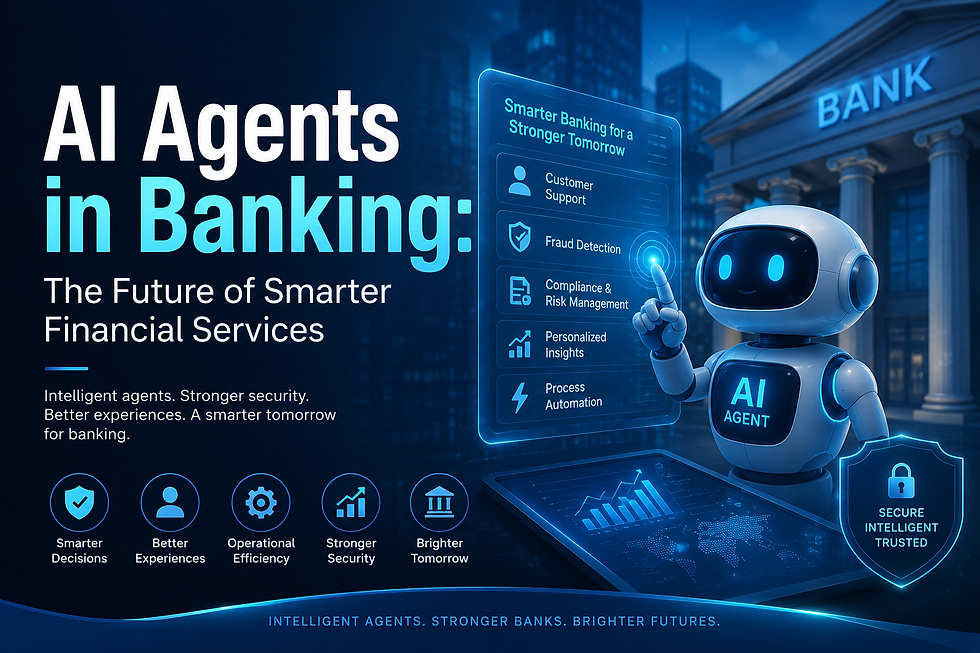
The banking industry is entering a new era where artificial intelligence is no longer limited to chatbots or simple task automation. Today, AI agents are changing how financial institutions operate by taking on complex, multi-step processes that previously required significant human effort. Unlike traditional automation tools that follow predefined rules, AI agents can understand context, make informed decisions, and execute tasks across multiple systems while maintaining compliance and security.
As banks continue to modernize their digital infrastructure, AI agents are becoming essential for improving operational efficiency, reducing costs, and delivering better customer experiences. From fraud detection and loan processing to compliance management and customer onboarding, these intelligent systems are transforming financial operations at every level.
Why AI Agents Matter in Banking
Traditional robotic process automation (RPA) and scripted chatbots work well for repetitive tasks, but they struggle when dealing with unstructured data or unexpected scenarios. AI agents, powered by large language models, machine learning, and enterprise knowledge bases, can analyze information, plan multiple actions, and adapt their responses based on changing business conditions.
This enables banks to automate complex workflows while maintaining accuracy and regulatory compliance. Instead of simply responding to commands, AI agents actively assist employees, improve decision-making, and accelerate business processes.
Key Applications of AI Agents in Banking
Intelligent Loan Processing
Commercial loan approvals often require reviewing financial statements, tax documents, credit history, and compliance records. AI agents can automatically collect, analyze, and summarize this information, allowing loan officers to make faster and more informed decisions. This significantly reduces processing times while improving accuracy.
Fraud Detection and Risk Management
Modern fraud schemes are becoming increasingly sophisticated. AI agents continuously monitor transaction patterns, identify suspicious activities, and detect anomalies in real time. When unusual behavior is detected, they can initiate additional verification steps, temporarily pause suspicious transactions, and alert fraud analysts with detailed investigation reports.
Customer Service Automation
Unlike traditional chatbots, AI agents provide intelligent, context-aware customer support. They can understand customer intent, access multiple banking systems, retrieve account information securely, assist with transactions, and even guide customers through complex financial services without requiring repeated interactions.
Compliance and Regulatory Reporting
Financial institutions must comply with strict regulations such as AML (Anti-Money Laundering), KYC (Know Your Customer), and KYB (Know Your Business). AI agents automate document verification, monitor compliance requirements, generate audit-ready reports, and maintain complete records of every decision for regulatory inspections.
Back-Office Process Automation
Banks perform thousands of repetitive administrative tasks every day. AI agents automate invoice processing, account reconciliation, document management, vendor verification, payment approvals, and exception handling. This reduces manual workload while increasing operational efficiency across departments.
How AI Agents Work
A typical AI agent follows a structured workflow designed to ensure both intelligence and reliability.
First, it gathers information from multiple internal and external sources, including customer records, transaction history, financial documents, and enterprise databases.
Next, it analyzes the available data using advanced reasoning capabilities and creates an execution plan based on business policies and compliance rules.
Before executing any action, the system validates every step against predefined governance policies, risk thresholds, and security requirements. Once approved, the AI agent performs the required operations by interacting with banking applications through secure APIs.
Finally, every decision, action, and system interaction is recorded in a complete audit trail, providing transparency for regulators and internal compliance teams.
Benefits of AI Agents for Financial Institutions
Financial organizations implementing AI agents can achieve measurable improvements across several business areas:
Faster loan approvals and customer onboarding
Reduced operational costs through intelligent automation
Improved fraud detection with fewer false positives
Better regulatory compliance and audit readiness
Enhanced customer experiences with personalized support
Increased employee productivity by eliminating repetitive work
Real-time decision-making using enterprise data
These benefits allow banks to focus more on strategic growth while maintaining high standards of security and governance.
Challenges to Consider
Despite their advantages, implementing AI agents requires careful planning. Banks must address challenges such as data privacy, cybersecurity, integration with legacy systems, model governance, and regulatory compliance.
Organizations should also establish strong AgentOps practices, including continuous monitoring, human oversight, model validation, and Retrieval-Augmented Generation (RAG) architectures to minimize hallucinations and ensure trustworthy outputs.
A successful deployment combines advanced AI capabilities with robust security controls, ensuring that every automated decision remains explainable, traceable, and compliant with financial regulations.
The Future of AI-Powered Banking
AI agents represent the next stage of digital transformation in banking. Rather than replacing employees, these intelligent systems augment human expertise by automating repetitive work, accelerating decision-making, and improving operational resilience.
As financial institutions continue investing in AI-driven innovation, autonomous workflows will become increasingly common across lending, payments, wealth management, compliance, and customer engagement. Banks that embrace AI agents today will be better positioned to reduce costs, improve service quality, strengthen security, and remain competitive in an increasingly digital financial landscape.
Read more: AI Agents in Banking


Comments